
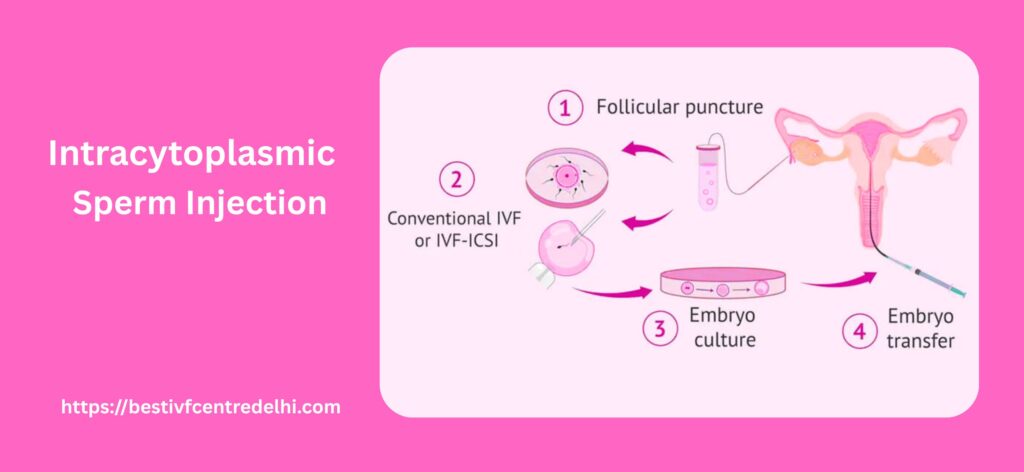
Intracytoplasmic Sperm Injection is an advanced form of IVF where a single healthy sperm is directly injected into an egg using a microscopic needle.
This technique helps couples achieve fertilization even when sperm count, motility, or morphology is extremely low.
Why Is ICSI Done? (When Doctors Recommend It)
Fertility specialists recommend ICSI when:
Male Factor Infertility
- Very low sperm count (Oligospermia)
- Poor sperm motility (Asthenozoospermia)
- Abnormal sperm shape (Teratozoospermia)
- Azoospermia (sperm retrieved surgically)
Other Situations
- Previous IVF cycles with poor fertilization
- Unexplained infertility
- Use of frozen sperm
- When PGT (genetic testing) is planned
- Couples using donor sperm
ICSI makes fertilization possible even with a single healthy sperm.
Step-by-Step ICSI Process Explained (2026 Updated Guide)
Below is the complete ICSI procedure used in leading Indian fertility centers like Vrinda Fertility.
1. Ovarian Stimulation (Hormone Injections)
The female partner receives hormone injections to help multiple eggs grow.
Doctors track:
- Follicle growth
- Hormone levels
- Ovary response
This phase lasts 10–12 days.
2. Egg Retrieval (OPU)
When the eggs are mature, doctors perform Ovulation Induction and collect eggs using:
- Ultrasound guidance
- A thin needle
- Light sedation
The process takes 15–20 minutes and is painless.
3. Sperm Collection / Retrieval
Sperm is obtained through:
- Regular semen sample
- TESA / PESA / Micro-TESE (surgical retrieval for azoospermia)
The embryologist prepares and selects the best sperm using advanced techniques like:
- Microfluidic sperm sorting
- Density gradient
- MACS
4. ICSI Micromanipulation (The Key Step)
This is the most crucial stage.
Embryologists use an advanced microscope to inject one healthy sperm directly into each mature egg.
This bypasses natural fertilization barriers.
5. Fertilization Check (After 18 Hours)
The fertilized egg is monitored for normal development.
Healthy embryos continue to divide and grow in incubators with AI-enabled monitoring.
6. Embryo Culture (Day 3–Day 5 or Day 6)Embryos grow into:
- Cleavage-stage embryos (Day 3)
- Blastocysts (Day 5/6)
Blastocysts have higher implantation rates.
7. Embryo Transfer (ET)
The best embryo is transferred into the uterus using a soft catheter.
This is painless and takes less than 10 minutes.
8. Pregnancy Test (β-hCG)
After 12–14 days, a blood test confirms pregnancy.
Benefits of ICSI in 2026
ICSI offers 7
Highest Fertilization Rate
0–80% fertilization, higher than conventional IVF.
Best Option for Male Infertility
Even extremely low sperm count can lead to successful fertilization.
Improved Embryo Quality
Advanced sperm selection boosts embryo quality and implantation.
Compatible With All Fertility Treatments
Works with:
- Donor eggs
- Donor sperm
- Frozen sperm
- PGTurrogacy
Reduces the Risk of Fertilization Failure
Nearly eliminates the chance of “no fertilization” in IVF cycles.
ICSI Success Rate in 2026 (India)
Success rates depend on age, egg quality, sperm health, and the clinic’s lab technology.
Average ICSI Success Rates in India (2026):
- Women < 35 years: 65%–78%
- Women 35–40 years: 45%–55%
- Women > 40 years: 20%–30%
Vrinda Fertility centers generally offer higher-than-average success due to advanced embryology labs and expert clinicians.
ICSI vs IVF: What’s the Difference?
| Feature | IVF | ICSI |
| How fertilization happens | Egg + sperm in a dish | Single sperm injected into egg |
| Best for | General infertility | Male infertility |
| Fertilization rate | Moderate | High |
| Risk of failed fertilization | Higher | Very low |
| Cost | Lower | Slightly higher |
ICSI Cost in India (2026 Guide)
The cost of ICSI varies based on city, lab technology, and additional procedures.
Average ICSI Cost in India:
₹1,20,000 – ₹2,50,000 per cycle
At Vrinda Fertility, the cost usually includes:
- Egg retrieval
- Sperm collection
- Embryo culture
- ICSI micromanipulation
- Embryo transfer
Additional charges apply for freezing, donor programs, or advanced sperm selection.
Why Choose Vrinda Fertility for ICSI?
Vrinda Fertility has become a trusted name in reproductive medicine due to:
Highly experienced embryologists
Advanced ICSI micromanipulation systems
AI-enabled embryo monitoring
Ethical, transparent care
Personalized treatment protocols
High success rates in male infertility cases
FAQs (Schema-Friendly)
1. Is ICSI better than IVF?
ICSI offers higher fertilization rates, especially in male infertility cases.
2. Is ICSI painful?
No, the procedure is painless because egg retrieval is done under sedation.
3. How long does ICSI take?
One complete cycle takes 4–6 weeks.
4. Can ICSI work with zero sperm count?
Yes, if sperm can be retrieved surgically (TESA/PESA/Micro-TESE).
5. What is the ICSI success rate?
Success ranges from 45–75%, depending on age and fertility factors.
6. Is ICSI safe?
ICSI is a globally accepted and safe procedure with excellent outcomes.
Conclusion
ICSI has revolutionized fertility treatment, especially in cases of male infertility. With advanced technology, precision micromanipulation, and expert embryology support, clinics like Vrinda Fertility are enabling thousands of couples to achieve parenthood successfully.
If you want the highest chances of fertilization, better embryo quality, and a personalized fertility journey in 2026, ICSI is one of the best available options.