
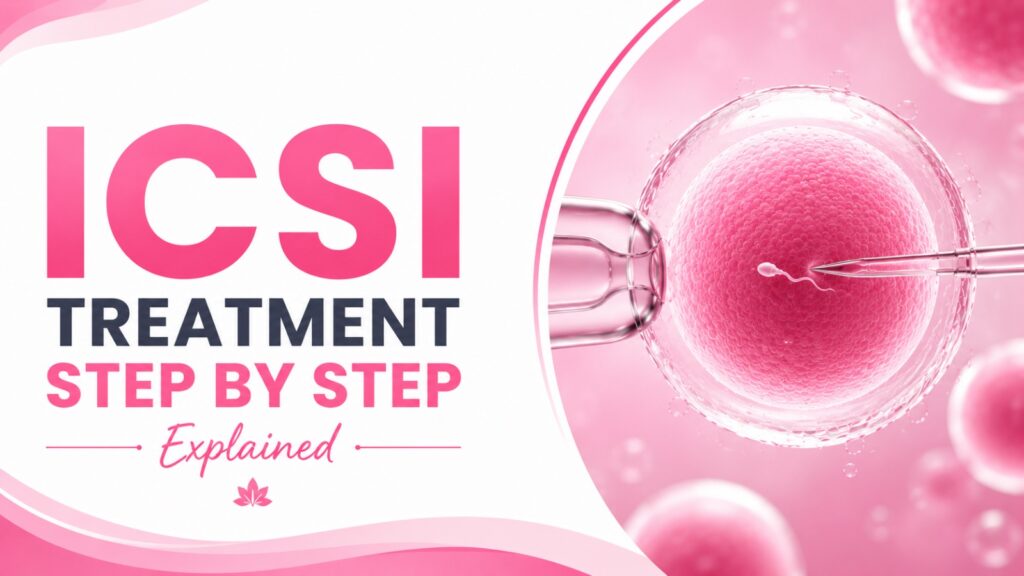
ICSI Treatment is one of the most sought-after treatments by couples. Between 50 to 80 million couples suffer from infertility and ICSI is one of the best ways to treat it.
If you want to know the step by step procedure for ICSI, you are in the right place. In this, we will take you through the complete procedure from the very first consultation to the pregnancy test.
Vrinda Fertility and Anushka Madan are among the best fertility specialists in India. If you are an Indian couple looking for a good fertility specialist, they are excellent options.
What Is ICSI Treatment?
Intracytoplasmic Sperm Injection (ICSI) is a form of IVF treatment and one of the best techniques to aid fertility. The best part about ICSI is that it helps couples who have a lot of issues regarding the quality of the sperm. A lot of the eggs in the IVF are surrounded by many of the sperm. In the case of ICSI, only one sperm is inserted into the surrounding egg through a microscope.
Currently, ICSI is one of the most successful reproductive technologies to help not only men with male-factor infertility, but also couples with unexplained infertility and couples who have had unsuccessful IVF treatments.
When is ICSI Recommended?
ICSI may be suggested by doctors in the presence of the following:
– Low sperm count.
– Poor motility.
– Abnormal morphology.
– Obstructive azoospermia.
– Previous unsuccessful IVF cycles.
– Sperm is retrieved surgically.
– Sperm is frozen.
– Unexplained infertility.
– Coupled with advanced maternal age in some cases.
A reproductive specialist will evaluate both parties before making a decision on the use of ICSI.
The ICSI Process
Knowledge of each step will allow couples to reduce their anxiety surrounding ICSI and prepare them for a journey that is often filled with frustration, disappointment, and uncertainty.
Step One: Fertility Evaluation
ICSI first begins with a comprehensive evaluation of both parties.
The evaluations will include the assessment of:
– Medical histories.
– Lifestyles.
– Previous pregnancies.
– Cycles and menstrual histories.
– Hormonal assessments and ultrasounds.
– Semen analysis.
Other imaging and genetic studies will be performed if further assessment is required.
At the top fertility centres such as Vrinda Fertility, treatment for couples is carried out on the basis of the unique medical conditions of each couple and not on a the basis of a general approach.
Step Two: Hormonal Stimulation of Ovaries.
Under natural circumstances, a female is capable of producing one egg every month. ICSI, however, requires ovaries to be stimulated in order to produce multiple mature gametes.
This is achieved by the use of targeted hormonal injections for a period of 8 to 12 days.
During this time, doctors will monitor the:
– Growth of ovarian follicles.
– Levels of other hormones.
– Endometrial thickness
Proper egg development before retrieval can be monitored with ultrasounds.
Step 3: Trigger Injection
When follicles reach the desired size, the patient is given a trigger injection. This shot helps eggs reach the last stage of maturation. Egg retrieval is scheduled for 34–36 hours after the trigger shot. The eggs can either be retrieved too early or too late which can negatively affect the success rate, hence, the timing is crucial.
Step 4: Egg Retrieval Procedure
This procedure is minimally invasive and performed under mild sedation. The fertility specialist, under an ultrasound, uses a thin needle to puncture the vaginal wall and collect the ovarian follicles that contain the mature eggs. This procedure usually takes
– 15–30 minutes
Most women go home that day after a short recovery. Though cramping and spotting can occur, very few women have serious complications.
Step 5: Sperm Collection
On the same day that the egg retrieval occurs, a sample of semen is also collected. The sample is processed by the embryology lab to obtain the sperm that is the healthiest and most motile. Sperm can also be obtained surgically if it can’t be obtained naturally using
– TESA
– PESA
– Micro-TESE
The sperm that is chosen is then prepared for the ICSI procedure.
Step 6: Intracytoplasmic Sperm Injection (ICSI)
This step of the process is the most intricate. An embryologist, under a high-power microscope, uses an elaborate micromanipulative system to inject a chosen sperm into a mature egg.
IVF that utilizes intracytoplasmic sperm injection (ICSI) does not rely on natural fertilization of the oocyte (egg) by the sperm.
ICSI techniques enhance the likelihood of successful fertilization in select cases.
Step 7: Determining Fertilization Success
After 16-18 hours, embryologists check the oocytes (eggs) to see if fertilization has occurred.
A healthy embryo will undergo fertilization and cell division in the days following.
Only those embryos that exhibit the desired pace of growth and development will be designated for transfer and freeze.
Step 8: Culturing the Embryos
The embryo will continue to undergo growth in an incubator that mimics the internal environment of the uterus.
The rate of embryo division will be under observation along with the degree of development and quality of the embryo.
Completion of embryo development to the blastocyst stage (approximately Day 5) will be preferable for embryo transfer and will have a better probability of implantation.
Step 9: Transferring the Embryo
Transfer of a selected and prepared embryo into the uterus via a thin and flexible catheter will be one of the simpler steps of the ICSI process.
The total transfer time is typically about 10-15 minutes.
Most women will find this procedure to be pain-free.
High quality embryos that will not be transferred can be cryopreserved for potential future use.
Step 9: The Pregnancy Test
Approximately 10 to 14 days post embryo transfer, a blood draw will be done to measure the pregnancy hormone (beta-hCG) to determine if pregnancy has been achieved.
A positive pregnancy test will be followed by confirming an early pregnancy via ultrasound.
Emotional support during this time will be paramount due to the anxiety caused by the long and uncertain wait.
Maturity Rate of ICSI
With ICSI gaining popularity as an effective form of assisted reproduction, taking the average successful pregnancy rate of ICSI across the globe is not truly indicative of how successful ICSI is as an effective form of assisted reproduction. ICSI is treatment of choice for couples when the female is of advanced reproductive age.
ICSI is effective when the quality of ova, sperm, embryos, and the condition of the uterus are optimal. ICSI is effective while considering the underlying cause of infertility. The expertise and experience of the fertility team and standard of the laboratories play a supporting role. The treatment outcome is significant when considering the age of the female partner. ICSI is an effective and proven method of assisted reproduction when the female partner is of reproductive age and has a good quality of ova.
Advantages of ICSI
Soon after the birth of the first child conceived through ICSI, it was noted that there was a clear and distinct advantage to using ICSI over all other conventional assisted reproductive techniques. The clear advantages of ICSI over all other conventional assisted reproductive techniques is:
– Greater rate of successful fertilization on the first attempt of fertilization
– Is the treatment of choice for male infertility
– Provides couples with a second chance when the previous cycle of IVF is unsuccessful
– Is the only method of assisted reproduction when the retrieved sperm was obtained through a surgical intervention
– Is the method of assisted reproduction when the embryo is of optimal development
– Provides couples with a clear and distinct increased rate of successful conception
– Is the only permitted method of assisted reproduction when the male partner has a significant spermotic disorder
ICSI has expanded treatment options for couples when all other assisted reproductive techniques have failed.
Are There Any Problems?
The safety of a medical procedure is a direct correlation to the experience of the fertility specialist. ICSI, like other assisted reproductive techniques, has some risk. The risks of ICSI are:
– The condition of ovaries is hyperstimulated
– Multiple pregnancies when embryos are transferred are the norm
– Bleeding which is of a minor nature after the extraction of the ova
– There is a risk of an infection which is very rare
– There is a risk of emotional trauma during the course of treatment
With constant monitoring the risks are minimized.
ICSI Recovery
Post ovarian extraction there is rapid recovery in women who undergo ICSI.
After the transfer of the embryos you may continue your daily routine unless instructed to do otherwise by your fertility specialist.
Fertility centres matter
In addition to medical advancements, the success of ICSI relies on the skills of the fertility team, the laboratory, and the level of care offered to each unique patient.
Vrinda Fertility offers state-of-the-art reproductive technology with the highest level of ethical practice and caring support throughout the fertility journey. Their methodology is based on science and they offer personalized treatment plans to each couple.
In the practice of Dr. Anushka Madan, patients receive full service fertility evaluations, and treatment plans with the highest level of evidence to support the success of the treatment. Dr. Madan offers an invaluable blend of skills with her clinical work and counselling patients.
For more information, please visit the following websites, Vrinda Fertility, located at vrindafertility.com , and Dr. Anushka Madan, located at dranushkamadan.com .
To Conclude
The knowledge of the ICSI treatment explained in detail, gives couples the ability to enter the fertility treatment process with a better understanding and expectations that are more reasonable. The different phases of the process, beginning with the consultation and continuing with the ovarian stimulation, the transfer of embryos, and the final pregnancy test, are all steps that are designed to optimize the likelihood of successful fertilization and the subsequent implantation.
Although every individual’s journey through infertility is different, selecting the right clinic and specialist can be of great value. The dedication of Vrinda Fertility and Dr. Anushka Madan to provide clients with sophisticated methods of reproductive care, along with treatment personalization and empathetic care, has earned them an outstanding reputation. Their modern clinic and professional expertise provide clients an assurance regarding their decision to further pursue parenthood through the ICSI process and other fertility treatments.
FREQUENTLY ASKED QUESTIONS
1.Is ICSI painful?
Egg retrieval is done under sedation, and the transfer of the embryos is done painlessly. Most of the steps taken during the treatment involve very little discomfort.
2.How long does the complete ICSI treatment take?
From the initial assessment to the pregnancy test, a complete cycle of ICSI takes about 4 to 6 weeks on average.
3.Will ICSI result in pregnancy?
No treatment for fertility is guaranteed to result in pregnancy. Several things play a role in the success of the treatment, such as the reproductive health as a whole, age, and quality of the embryos.
4.Is bed rest a must after embryo transfer?
A period of long bed rest is generally not needed. Most of the doctors who specialize in fertility encourage their patients to return to their normal daily routines. However, they are to abstain from any heavy physical activities.